Separation and exile
Doctor ZhivagoSeparation and exile in Doctor Zhivago describe the breaking apart of families and lovers under the pressure of social upheaval, displacement, and uncertain journeys. They are more than separations across distance: the collapse of familiar domestic life leaves people feeling exposed and homeless, while memories and acts of writing become ways to preserve bonds that events have made impossible to sustain in person.
Separation amid upheaval
The novel gives separation a historical as well as intimate meaning. Tonia explains that the damage to families cannot be reduced to differences in temperament or to whether people love one another. Customs, traditions, household order, and the whole inherited way of life have crumbled in the general reorganization of society. In the aftermath, she says, the human soul is left stripped of the arrangements that once sheltered it, still reaching toward another equally lonely person. Separation is therefore not simply a choice made by individuals: it is one of the forms that social destruction takes inside private life.
Tonia imagines herself and Yurii as Adam and Eve at the end of the world, naked and without a home, yet also as the last remembrance of the many centuries of human creation that lie between those first and final moments. The image holds loss and continuity together. Their life together has been broken by upheaval, but the remembered inheritance of human life still gives their love and grief meaning. Exile makes home precarious; memory makes it possible to carry something of home across the distance.
Yurii’s imagined reunion
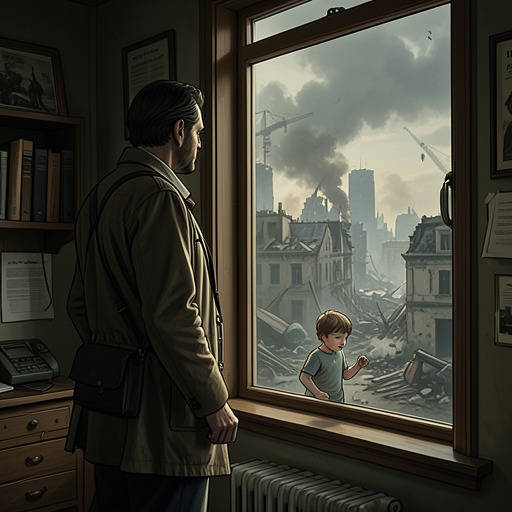
When Yurii hears that his family has been in Yuriatin on its journey to Moscow, the news opens a painful vista of what he cannot know. He imagines Tonia, their son Sasha, and her father, Alexander Alexandrovich, safely arrived, wonders how they managed the journey, and asks whether their house is still standing. He also recalls that Tonia was pregnant and rebukes himself for repeatedly forgetting that she must have given birth. These thoughts are not confirmation of what has happened to his family: they expose the uncertainty in which he lives, trying to assemble a picture of their lives from fragments and possibilities.
His imagined questions turn into promises of reunion. He pictures himself walking all the way to find Tonia and hopes that the family will be together again, while the repeated prospect of separation overwhelms him. The passage moves between his fears for them and the jealousy that has just seized him; one anxiety displaces another, but neither is resolved. His family’s distance is thus registered not as a settled fact he can understand, but as a continuing mental condition in which hope, guilt, and fear crowd together.
Tonia’s farewell letter
Tonia’s letter gives the separation a voice from the other side. She says that the family may be going to Paris, though nothing is settled, and reports that Sasha has grown into a strong boy. When the family speaks of Yurii, Sasha cries and cannot be comforted. The detail makes their absent father part of the household’s daily emotional life even as the household is moving beyond his reach. Tonia also says that her father sends greetings and blesses Yurii for the trials and uncertainties ahead.
She writes without reproaching him, saying that he may do as he pleases with his life and that she will be happy if he is well. Her farewell does not erase the marriage: she calls him her husband and the father of her children, even as she fears they will never meet again. The letter’s approaching departure gives these statements urgency. Those coming for it are hurrying her, and she compares their arrival to being taken to her death. The prospect of exile is conveyed through the threatened finality of the parting, not through certainty about what awaits the family in Paris.
Tonia also recalls getting to know Larisa Feodorovna in the Urals and thanks her for staying beside her during a difficult time and helping her through childbirth. She recognizes Lara as a good person while describing their temperaments as opposites: Tonia seeks simplicity and sensible solutions, whereas Lara tends toward complication and confusion. This acknowledgment makes the relationships among the separated characters more intricate than rivalry alone. At the moment when Tonia is saying goodbye to Yurii, she can also name Lara’s care for her.
Lara’s departure and Yurii’s response
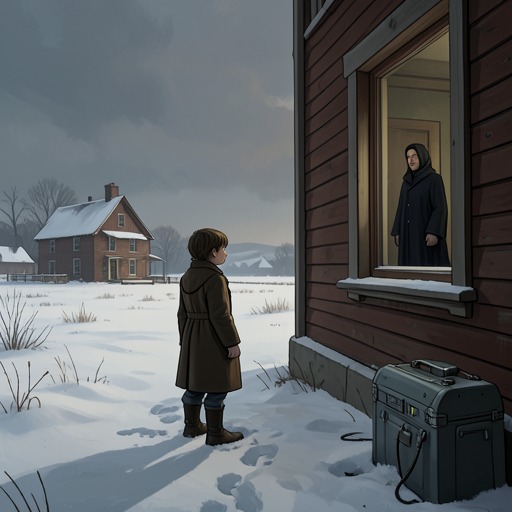
Lara’s departure from Varykino turns separation into a visible event for Yurii. He watches the sleigh sweep past and disappear, and understands that the moment has come and gone. His farewell to Lara reaches beyond any promised earthly meeting: he imagines seeing her again in another world and calls her his inexhaustible, everlasting joy. The distance created by her departure is at once concrete and absolute in his perception; he believes he will never see her again.
Afterward, grief heightens Yurii’s attention to the winter evening. The landscape seems newly present to him, as though the dusk and trees had appeared for the first time to witness and console his bereavement. The scene slows around the departure rather than treating it as a passing plot point: the sleigh vanishes, daylight fades, and the surrounding world becomes the measure of what he has lost. Nature does not undo the separation, but his altered perception gives grief a setting in which it can be registered.
Inside the house, Yurii’s thoughts divide between practical survival and an inward conversation addressed to Lara. He plans to go to Moscow, keep himself from sleeping, work until exhaustion, and heat the bedroom. Alongside these immediate tasks, he promises to remain with her in memory and to put his grief into enduring work. The separation therefore becomes a problem of form: Lara is absent, but he hopes to preserve her through a written image shaped by their life together.
Yurii imagines life’s storm casting Lara onto his shore, like a receding tide leaving a line of objects on the sand. The image makes their meeting part of the same force that has scattered them. His planned writing cannot restore their shared life, but it can give the encounter a form that outlasts the moment of departure. Once inside, he sees the bedroom Lara had tidied that morning now disordered by her hurried packing; he weeps, then turns to the vodka Komarovsky left behind. The room’s changed state makes the absence tangible, while his movement from grief to practical action echoes the divided inward monologue through which he tries to endure it.
Memory as a form of attachment
Across these episodes, separation recurs in different forms: Yurii’s uncertain imaginings about his family, Tonia’s letter from the threshold of exile, and Lara’s departure from Varykino. Each leaves a different trace. Yurii’s questions preserve hope without resolving what has happened; Tonia’s letter carries affection and family news across distance; and Yurii’s promise to write Lara turns bereavement toward artistic memory. None of these forms cancels exile or guarantees reunion. They show instead how attachment persists when shared homes and ordinary companionship have been made fragile by upheaval, and how memory and art become means of holding onto a relationship that distance has altered but not erased.